Off the Grid, On the Edge: Why Africa's Solar-Powered Micro Data Centers May Outdesign America's
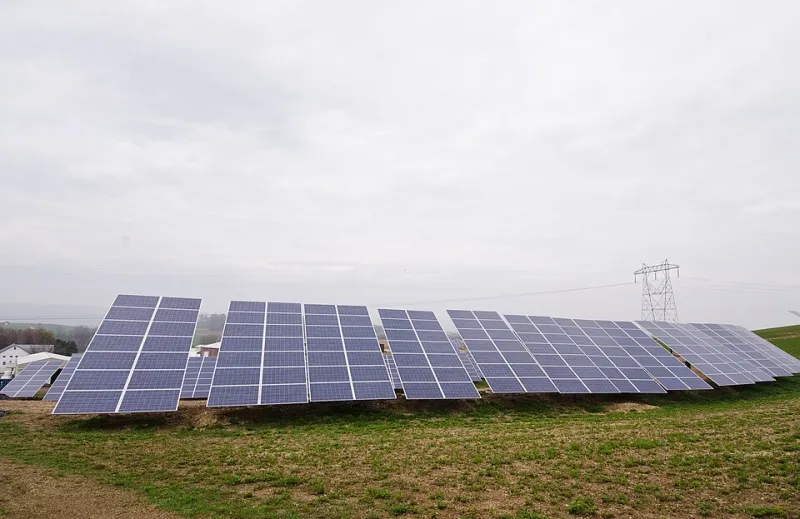
Photo: USDAgov, Public domain, via Wikimedia Commons
There is a quiet irony in American infrastructure policy right now. Data centers have become the fastest-growing load on US power grids, with utilities in Virginia, Texas, and Georgia pausing new connections as hyperscale campuses devour megawatts. Meanwhile, in markets where grid reliability is a punchline rather than an assumption, African engineers have spent the last several years building something the US may soon need: data centers that don't depend on the grid at all.
This is not a story about deprivation producing virtue. It is a story about constraints producing design. And American infrastructure planners should pay attention, because the design is working.
The Constraint That Became a Feature
The premise of the American data center is centralization: build enormous, find abundant power, cool it, and ship the data over fiber. The premise of the African model is the opposite. Where power is intermittent and transmission infrastructure thin, the rational architecture is small, distributed, and self-powered.
Companies across the continent have proven the economics. Solar-plus-battery micro data centers — some the size of a shipping container, some the size of a closet — now serve content caching, mobile money processing, and IoT workloads in locations no diesel-dependent facility could profitably reach. Firms like Nigeria's Rack Centre and Kenya's distributed infrastructure players, alongside global edge operators working in African markets, have demonstrated that renewable-powered microsites can deliver reliable uptime with dramatically lower energy overhead than grid-tied hyperscale equivalents.
The numbers matter here. Cooling can consume 40% of a traditional data center's power budget. Micro facilities sited close to users, running efficient ARM-based compute, and cooled passively or with thermal management designed for African climates, cut that figure sharply. When the power source is solar with battery storage, the carbon math stops being an offsetting exercise and becomes an operating advantage.
What the US Is Getting Wrong
The American response to data center energy strain has been, predictably, to scale the old model: negotiate utility deals, reopen nuclear plants, and site campuses wherever transmission capacity exists. That approach made sense when compute was centralized by default. It makes less sense as edge computing becomes the dominant demand driver.
Consider what a distributed fleet of solar-powered micro data centers would solve for the US: transmission losses from hauling data and power across continents of distance; the political friction of gigawatt-scale utility negotiations; the water conflicts erupting in Arizona and Texas; and the single points of failure that grid dependence creates. A distributed architecture also matches how modern workloads actually behave — content delivery, AI inference, and payment processing all benefit from proximity to users, not proximity to cheap coal.
The Engineers Who Made It Work
The unsung heroes of this shift are the infrastructure engineers who treat power instability as a design parameter rather than an excuse. Their playbooks — load-shedding-aware scheduling, battery-sizing for monsoon and dry-season variance, hardware refresh cycles tuned to harsh environments — read like survival guides. They are also, increasingly, the most relevant documentation in the industry.
The talent pipeline reinforces the point. African universities and companies have produced a generation of engineers fluent in hybrid power systems out of necessity. As American firms staff their sustainability teams, this expertise is becoming an import, not an export.
A Modest Proposal for American Infrastructure
Nobody is suggesting Virginia replace its hyperscale campuses with solar containers. Hyperscale compute has genuine economies of scale, and AI training will remain a centralized workload for the foreseeable future. But the US edge tier — the caching, the inference, the last-mile processing — is exactly where the African model belongs.
The argument can be put simply. America built its data center model on the assumption of infinite cheap power. That assumption has expired. Africa built its model on the assumption of no reliable power at all — and it turns out that assumption produces infrastructure that is cheaper, cleaner, and closer to the user. The next decade of American infrastructure debates will be fought over grids and gigawatts. The smarter conversation, the one happening quietly in Lagos, Nairobi, and Accra, is about whether the grid was ever the right answer.