Continent-Built, Globally Competitive: How African AI Teams Are Outpacing Expectations Without Silicon Valley Budgets
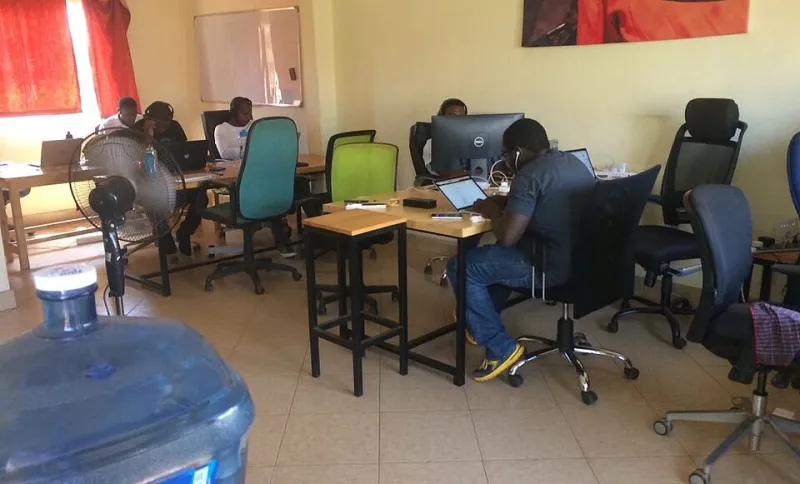
Photo: Aziwa1991, CC BY-SA 4.0, via Wikimedia Commons
The prevailing assumption in many Western technology circles is that meaningful artificial intelligence development requires three things: deep-pocketed venture capital, proximity to elite research universities, and access to the kind of computational infrastructure that only the wealthiest tech corridors can sustain. African AI teams are systematically dismantling that assumption — one deployment at a time.
From agricultural yield prediction platforms in Ethiopia to multilingual natural language processing engines designed for Swahili, Yoruba, and Hausa speakers, a cohort of engineers and data scientists across the continent is producing AI-powered products that are not merely functional but genuinely innovative. The methods they use, and the constraints they navigate, offer a compelling alternative model for the global technology industry.
The Open-Source Advantage
Where Silicon Valley startups routinely spend millions licensing proprietary machine learning infrastructure, many African AI teams have built their technical foundations almost entirely on open-source tools. Frameworks such as TensorFlow, PyTorch, and Hugging Face's Transformers library have democratized access to state-of-the-art model architectures, allowing small, underfunded teams to punch well above their weight class.
Nairobi-based Zindi, a data science competition platform focused on African challenges, has become a proving ground for this open-source-first philosophy. The platform hosts machine learning competitions that draw thousands of participants from across the continent, crowdsourcing solutions to problems ranging from crop disease detection in East Africa to tuberculosis screening in low-resource clinical settings. Winners frequently publish their approaches openly, accelerating the collective knowledge base rather than locking insights behind proprietary walls.
"When you cannot afford to buy your way to a solution, you are forced to engineer your way there," noted one Nairobi-based data scientist who has competed in more than a dozen Zindi challenges. "That constraint produces a different kind of problem-solver."
Regional Datasets as Competitive Moats
Perhaps the most underappreciated advantage held by African AI teams is their access to — and deep understanding of — regional datasets that simply do not exist anywhere else. Training a language model on English-language Wikipedia text produces a tool optimized for English-language contexts. Training a model on Pidgin English conversations scraped from Lagos social media platforms, or on Amharic agricultural extension service records, produces something far more valuable to the populations those models are meant to serve.
Umuzi, a South Africa-based tech education and talent development organization, has been quietly assembling one of the continent's most valuable repositories of African-language training data. The organization's work on low-resource language models has drawn interest from researchers at Google and Meta, both of whom have publicly acknowledged the limitations of their own multilingual models when applied to African linguistic contexts.
Masakhane, a grassroots research collective founded in 2019 and now spanning contributors from more than 30 African countries, has published peer-reviewed natural language processing research that has been cited by some of the most prestigious machine learning conferences in the world, including NeurIPS and ACL. The collective's work on machine translation for African languages has filled a gap that commercial technology giants had neither the incentive nor the contextual knowledge to address.
Case Study: Ubenwa and the Sound of Innovation
Few African AI startups illustrate the continent's capacity for globally relevant innovation more vividly than Ubenwa, a Nigerian-Canadian venture that uses acoustic analysis and machine learning to detect birth asphyxia — a leading cause of neonatal mortality — from a newborn's cry. The company's founding team, led by Dr. Charles Onu, developed the core technology during doctoral research at McGill University before commercializing it with a focus on under-resourced clinical environments in sub-Saharan Africa.
Ubenwa's product does not require expensive imaging equipment or specialized laboratory infrastructure. It requires a smartphone and a trained model. That design philosophy — maximum clinical impact at minimum deployment cost — reflects a set of constraints that African health systems impose on innovators, and which inadvertently produce solutions with enormous applicability in low-resource settings everywhere from rural India to underserved communities in the American South.
The Talent Pipeline: Pressure Points and Progress
The momentum building across Africa's AI ecosystem is not without friction. Talent retention remains the most acute challenge facing homegrown technology companies. Major technology corporations including Google, Microsoft, Amazon, and Meta have established or expanded research and engineering offices on the continent in recent years — Google's AI research center in Accra, opened in 2019, was the company's first on the African continent — and they compete aggressively for the same engineers that African startups are trying to build their teams around.
The compensation gap between a senior machine learning engineer at a Lagos startup and the same professional employed remotely by a US-based technology firm can be substantial, even when adjusted for local cost of living. Founders across the continent describe a constant calculus: invest in developing junior talent and risk losing them to international employers once their skills mature, or compete on culture, equity, and mission to retain engineers who have options.
Some organizations are attempting to bend this dynamic in their favor. Andela, which began as a talent outsourcing platform connecting African engineers with international clients, has evolved into a broader technology talent network that has placed thousands of engineers in roles across the globe while maintaining a significant presence on the continent. The model has generated debate — critics argue it accelerates brain drain while proponents contend it raises the global market value of African technical talent across the board.
Why the World Is Finally Paying Attention
The international technology industry's growing interest in African AI talent is not purely philanthropic. It reflects a hard-nosed recognition that some of the most difficult unsolved problems in applied machine learning — low-resource language modeling, health diagnostics in infrastructure-constrained environments, financial fraud detection in informal economies — are problems that African teams have been working on, by necessity, for years.
When a team in Kigali has spent three years fine-tuning a fraud detection model for mobile money transactions conducted over feature phones with intermittent connectivity, they possess institutional knowledge that no amount of Silicon Valley funding can instantly replicate. That knowledge has real commercial value, and the global market is beginning to price it accordingly.
For US-based technology investors and enterprise technology buyers watching these developments, the implications are significant. Africa's AI ecosystem is not a charity case awaiting rescue from Western capital. It is a competitive, rapidly maturing innovation environment that is producing solutions, talent, and intellectual property that the global industry increasingly cannot afford to ignore.
The data revolution, it turns out, does not require a Silicon Valley zip code.